
Blog
Water Chestnut Jelly and the Crunch of Osmanthus
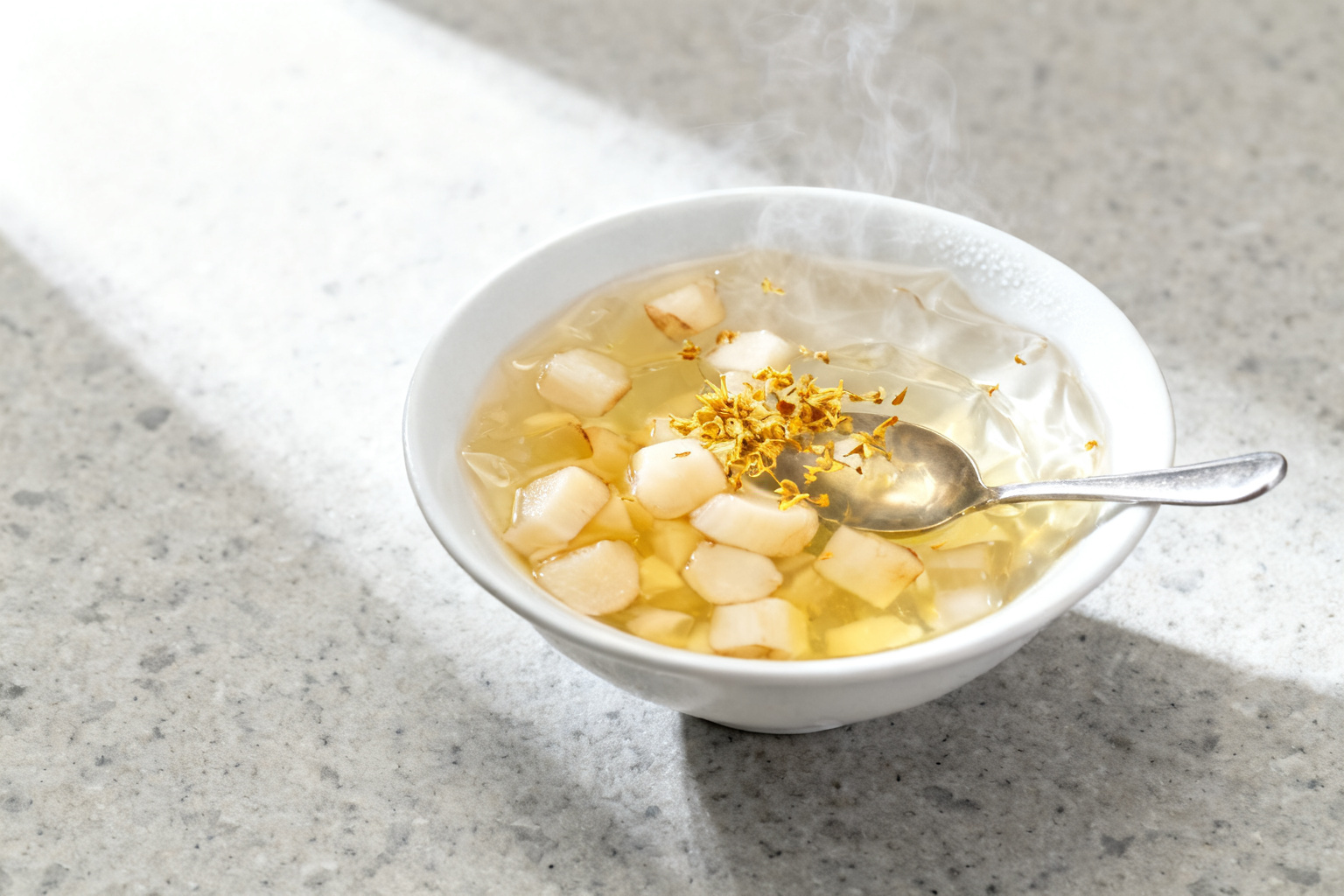
The crunch in the name belongs to the water chestnut. Osmanthus is a small dried flower, and what it brings to a cold jelly is not sound but the half second before the first bite: a soft, apricot-like perfume that lifts off the surface of the cup. Put the two together and you get one of the quietest desserts in the Cantonese repertoire, a clear and faintly trembling set with something firm hidden inside it, and a floral note light enough that you notice it twice, once on the nose and again at the back of the throat.
The argument of this piece is simple. A water chestnut jelly lives on contrast rather than sweetness: a set soft enough to collapse under a spoon, pieces firm enough to be heard, and just enough osmanthus to stop the bowl from reading as cold sugar water. Everything below follows from that, the way the jelly sets, the way the chestnut keeps its bite, the way the flower behaves in the cold, and the way the whole thing is best eaten.
In This Article
- A Water Chestnut Jelly Is a Texture Argument Before It Is a Flavour One
- Clarity Is the First Thing You See and the Last Thing That Matters
- The Crunch Comes From the Corm, and It Survives the Chill
- Osmanthus Is a Top Note, and Top Notes Do Not Last
- Cold Holds the Set Together and Holds the Aroma Back
- Served Plain, in a Small Bowl, It Does Not Need a Topping
A Water Chestnut Jelly Is a Texture Argument Before It Is a Flavour One
Most jellies ask you to like a flavour. Water chestnut jelly asks you to notice a difference. At its best it is barely sweet, faintly starchy in the way fresh corn is starchy, and uneven on purpose: soft, then firm, then soft again inside one spoon. That unevenness is the design, not an accident of mixing. A smooth, uniform block with the same flavour would be pleasant for two bites and dull for the rest.
It also explains the portion. Contrast is tiring in quantity. Three or four spoonfuls keep the crunch surprising, while a large tub of the same thing turns the texture into a chore, in the way that a plate of nothing but crisp vegetables becomes a chore. Small bowls are portioning by texture rather than by fashion.
Sweetness has to stay low for the same reason. Sugar coats the tongue and flattens the gap between yielding jelly and firm pieces, so a jelly that tastes of syrup tastes of one texture instead of two. What you want is a set that tastes of the ingredient first, with sugar arriving late and lightly, and a floral note sitting above both without pressing down on either.
There is a home version and a bought version, and they are not quite the same dish. Made at home, the jelly is usually set in a tray, chilled, and cut into slabs, so the edges are firmer and the pieces are further apart. A cup version compresses all of that into a single spoonful, which means the balance between soft and firm has to hold in every bite rather than varying from slab to slab. Getting that balance right is what separates a good cup from a merely sweet one.
Clarity Is the First Thing You See and the Last Thing That Matters
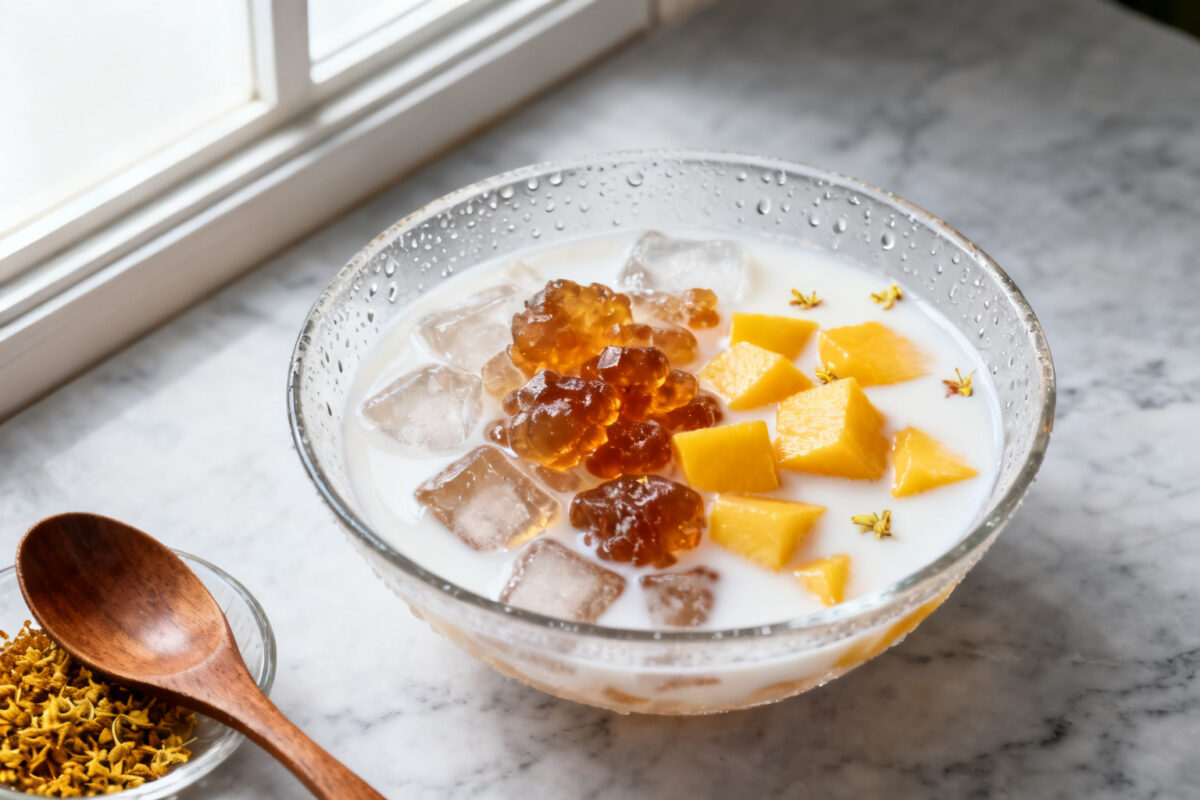
Balance of that kind starts with what you can see. A crystal jelly dessert is judged with the eyes before the spoon arrives: the set should look like weak tea held in place, clear enough to read the bottom of the bowl through it, with the chestnut pieces sitting where they settled instead of hanging in a cloud. Clarity comes from the gelling agent and from how carefully the liquid was strained before it set, and it is both the easiest thing to get right and the easiest thing to overrate.
What clarity actually tells you is how the jelly will break. A very clear, tight set snaps cleanly under a spoon and releases a little liquid as it does. A softer, slightly hazier set slumps instead, and the slump is often the more pleasant thing in the mouth, because it spreads across the tongue rather than sliding over it. Neither is wrong on its own. What matters is whether the set matches the pieces inside it. A firm jelly around large, hard pieces fights the spoon; a soft set around the same pieces gives way around them.
The useful test is a teaspoon, not a photograph. Press the edge of the spoon into the surface. If it goes in with small, even resistance and comes out with a clean lip of jelly, the set is balanced. If the spoon sinks without resistance, the jelly will collapse before it reaches your tongue and you will taste sugar and nothing else. If the spoon bends, the set is too tight and the crunch will feel like an obstacle instead of a lift.
The Crunch Comes From the Corm, and It Survives the Chill
The set is only half of the contrast. The other half is the thing suspended in it. A water chestnut is not a nut but a corm, the swollen underground stem of a sedge grown in shallow water, dark brown outside and dense and white inside. Raw, it snaps. It is mildly sweet, a little starchy at the finish, and it stays louder in the mouth than its flavour suggests, which is a rare thing in a vegetable.
Heat changes it. Cooked for a while, water chestnut goes from snapping to yielding, and the sweetness rounds out as the starch softens. Inside a chilled jelly the pieces never spend long on heat, so they keep the raw snap and the faint starchiness that comes with it, which is why the crunch in a good cup sounds dry and clean rather than wet. It is also why that crunch fades if the cup is left in a warm room or eaten slowly on a hot afternoon.
Fresh and canned corms are not the same instrument. Peeled fresh water chestnuts have a fine, watery snap and a sweetness that sits close to the surface. Canned ones are softer and more uniform, often sweeter in a flatter way, because they have been sitting in liquid. Both can work in a jelly. Only one of them makes you stop and listen, and it is the one that tastes of the vegetable rather than of the can. Which one a given cup uses is a question for its label.
The size of the cut matters too. Small dice give a crunch that arrives and leaves inside one chew, so the jelly dominates; larger pieces hold their firmness longer and turn each spoonful into a negotiation between soft and hard. What does not work is a mixture so uneven that one bite is all jelly and the next is all chestnut, which is why the pieces in a good cup tend to be cut to a similar size.
Osmanthus Is a Top Note, and Top Notes Do Not Last
If the chestnut supplies the body of the dessert, the flower supplies its timing. Osmanthus fragrans blooms in autumn and smells of apricot and peach with something clean underneath, which is a strange description until you meet it. In Chinese sweets the blossoms are used dried or held in syrup, and the flavour they give is thin and high, closer to perfume than to fruit. In an osmanthus jelly the flower has one job: to float above the chestnut rather than compete with it.
That is also why a floral chinese jelly is easy to get wrong. A heavy hand with the blossoms turns the whole cup soapy, and soapiness does not fade with the second spoon, it settles in. The right level is the level at which you notice the aroma when you lift the lid, nearly lose it while chewing, and catch it again at the end. When the balance is right, the chestnut comes first and the flower second, and the reverse order is a warning sign.
Aroma is the most temperature-sensitive part of the dessert. Volatile compounds rise faster in a warm room, which means a cup taken straight from the fridge smells of less than the same cup ten minutes later. That is not a flaw in the recipe, it is a fact about cold food, and it is the main argument for not eating this one at refrigerator temperature.
There is a second reason the flower has to stay light. Osmanthus aroma sits close enough to peach and apricot that a heavy dose reads as fruit, and once it reads as fruit, the dessert changes category in your head, from a clear and cold thing to something nearer a fruit cup. Keeping the note faint keeps the jelly where it belongs, in the family of cold, clean, lightly sweet bowls that close a meal without weighing it down.
| Part of the Spoonful | What It Adds | What It Needs From the Rest |
|---|---|---|
| The clear set | Something for the spoon to break, and a surface to carry the aroma | Pieces no bigger than it can close around |
| The water chestnut | Firmness, a dry snap, a faint starch at the finish | A set soft enough to give way first |
| The osmanthus note | An apricot-like lift that arrives before the sugar does | Cold to hold it back, then a few minutes of warmth to release it |
Cold Holds the Set Together and Holds the Aroma Back
Everything in this dessert moves in opposite directions as the temperature changes. Cold firms the set, keeps the pieces suspended, and dulls both the sugar and the flower. Warmth does the reverse: the jelly softens toward a slump, the sweetness comes forward, and the osmanthus finally opens. The best moment for most people is somewhere between the two, when the set still holds its shape on the spoon but has lost the hard edge it had straight from the fridge.
There is a simple way to find that moment. Take the cup out, open it, and leave it on the counter while you set the table or make tea. By the time you sit down the surface will have gone slightly glossy and the aroma will have lifted. Outdoors on a hot day the window is short and the jelly will soften quickly, which is not a disaster, since a slack set is not a spoiled one.
Very cold also changes how the crunch feels. At fridge temperature the chestnut pieces seem harder than they are and the contrast reads sharper than it really is. Let the cup stand for a few minutes and the same pieces feel crisper and sweeter, because your mouth is getting texture and taste at once instead of resistance alone. This is the one adjustment worth making, and it costs nothing but patience.
Served Plain, in a Small Bowl, It Does Not Need a Topping
The last decision is what goes on top, and the answer is usually nothing. Chinese sweet shops will offer condensed milk, coconut cream, syrup or dried fruit for almost anything clear, and a jelly is a common target. Most of it is unnecessary here, because a sauce adds a third, softer texture over the two you came for. If you want to add something, add a texture instead: a few extra slices of fresh water chestnut, or a spoon of something cold and crunchy.
The vessel matters less than the size. A small bowl or a chilled teacup with a teaspoon is enough. Eating straight from the cup is fine at a desk, and turning it out into a bowl is better at a table, because the pieces distribute more evenly once the jelly is broken. Either way, take small spoonfuls rather than loading the spoon. The crunch registers once per bite, and a full spoon of jelly buries it.
This is the reasoning behind Osmanthus Water Chestnut Jelly: a clear, crisp set jelly with a light floral note, chilled and ready to eat. Nothing has to be added, and nothing has to be done beyond opening it and giving it a few minutes on the counter. If you want the wider context, the wellness Chinese desserts collection is where this kind of small, cold, lightly sweet bowl belongs.
One Thing to Remember
What separates a good chilled jelly from a merely sweet one is contrast: a set soft enough to give way and pieces firm enough to be heard. Osmanthus only has to sit above that, lightly, and the dessert holds together.
Frequently Asked Questions
What does water chestnut jelly taste like?
Mildly sweet and faintly starchy, with a clean, watery freshness from the chestnut and almost no acidity. Most of the impression comes from texture rather than flavour: a soft set that gives way around firm pieces.
Is osmanthus jelly the same thing?
They describe the same clear, chilled style of dessert from different angles. In an osmanthus jelly the flower is the headliner; when water chestnut is added for crunch, the chestnut takes the front and the flower becomes the note above it.
Should it be served cold or closer to room temperature?
Cold from the fridge keeps the set firmest and the pieces suspended, but it mutes the floral aroma. A few minutes on the counter gives a softer set and a much clearer osmanthus note, and it is worth trying both to see which you prefer.
Do you need to add anything before eating it?
No. A small bowl and a teaspoon are enough, and most toppings cover the two textures the dessert is built on. If you want extra contrast, add more crunch rather than more sweetness.
Try It Yourself
The bowls mentioned in this article, straight from our kitchen.

Osmanthus Water Chestnut Jelly
View Product