
Blog
What Makes Roselle Flower Jelly So Pleasantly Tart
Most desserts announce themselves with sugar. Roselle flower jelly does the opposite: the first thing that reaches the tongue is a bright, direct sourness, and only afterwards does any sweetness arrive to round it off. That order surprises anyone who expects a jelly to behave like candy, and it is the reason this particular dessert is worth paying attention to. It is also the reason a carelessly served version tastes harsh while a well served one tastes clean.
The tartness is not a flaw to be corrected with more sugar, and it is not a squeeze of lemon stirred in at the last minute. It belongs to the plant, it behaves differently at different temperatures, and it asks for a particular kind of set to taste right. Those three facts explain almost everything about how the dessert should be eaten, from the temperature of the first spoon to the size of the portion.
In This Article
- The Sourness Comes From the Calyx, Not From the Recipe
- A Clear Jelly Carries Acid Better Than a Creamy One
- Cold Sharpens the Tartness Rather Than Hiding It
- The Citrus Note Keeps the Sourness From Turning Flat
- Sweetness Adjusts the Ratio, It Does Not Remove the Acid
- Set and Chilled, Roselle Reads Differently Than It Does Hot
The Sourness Comes From the Calyx, Not From the Recipe
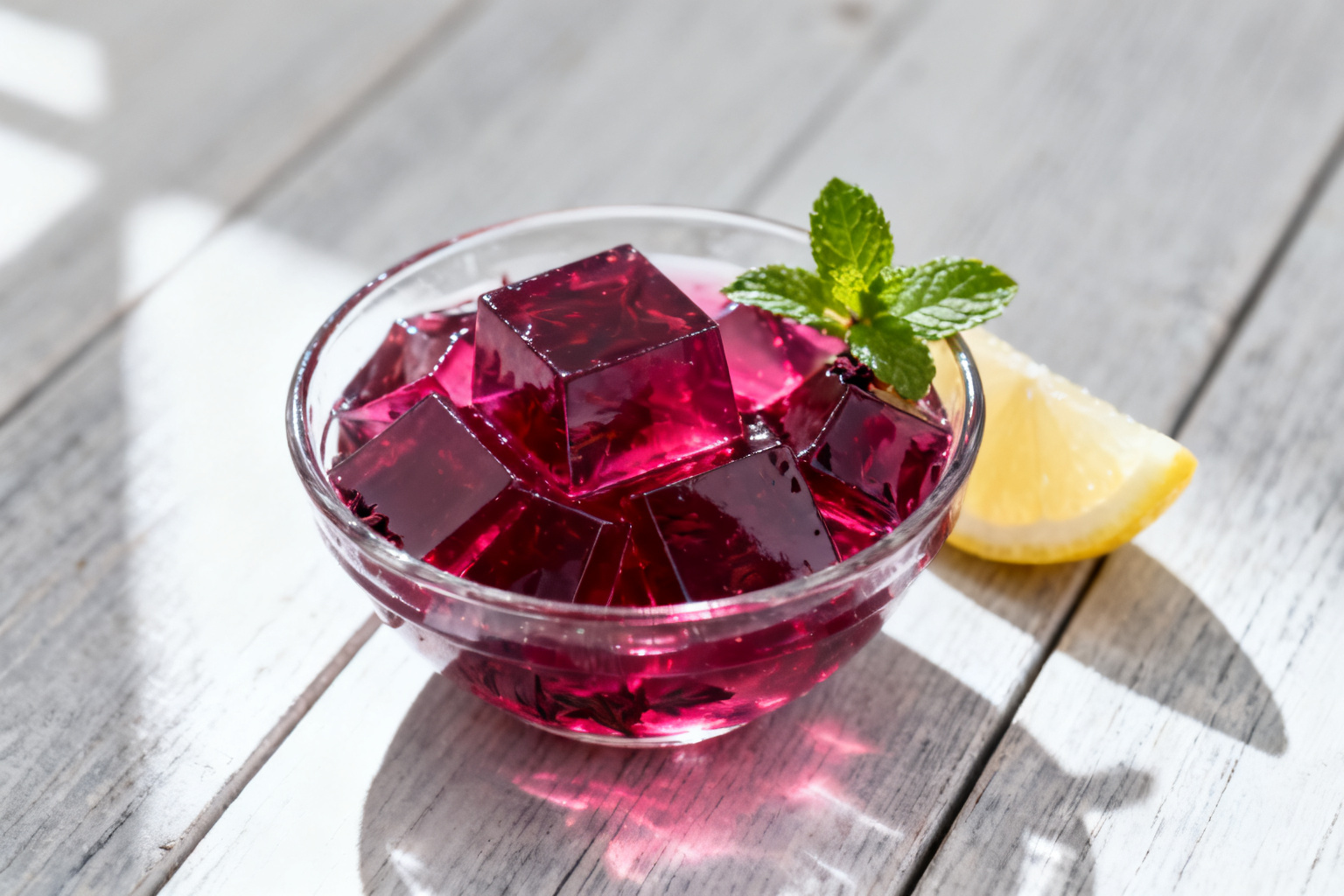
Roselle (Hibiscus sabdariffa) is grown for its calyces, the fleshy red sepals that close around the seed pod once the flower has dropped. Those calyces are naturally high in organic acids, which is why a handful of them steeped in hot water turns into a sharply sour drink with nothing else added. The sourness is part of the raw material rather than a step in the kitchen, and that changes how it tastes in the mouth.
That distinction matters for a tart jelly dessert, because acid that arrives with its own aroma behaves differently from acid that arrives alone. Roselle brings a red fruit note with it, round and fruity rather than flat and sharp, and that note outlasts the sweetness that follows. The sourness has a shape and a smell, not just a position on a scale from mild to strong.
It also means the flavour is not uniform from the first spoon to the last. Acid shows up first, fruit comes up behind it, and the finish stays dry rather than syrupy. A jelly built on roselle does not need much help to be interesting. It needs the person eating it to notice what is already there before reaching for something sweeter.
A Clear Jelly Carries Acid Better Than a Creamy One
If the acid belongs to the fruit, the texture decides how it lands. On a soft, creamy base a strong acid tastes faintly wrong, because fat and acid pull in opposite directions and the mouth reads the combination as spoiled. On a clear, firm hibiscus jelly the same acid reads as clean. The jelly breaks under the spoon, gives up a little syrup, and then disappears, taking the sourness with it.
The set has to be firm enough to do that work. A jelly that collapses into liquid leaves the acid sitting on the tongue with nothing to carry it, and the sourness starts to feel like a chore rather than a pleasure. A jelly that holds its edge gives each spoonful a beginning and an end, which is the difference between a sharp flavour that refreshes and one that simply tires the mouth.
Because the body is clear rather than rich, the acid stays the main event and fat never gets a vote. That is a different sort of satisfaction from a cream dessert, and it is why a small portion is usually enough. Two or three bites in, the palate is awake and the dessert has done its job. Anything larger starts to taste like a second helping of the same idea.
Cold Sharpens the Tartness Rather Than Hiding It
Chill the same jelly and the balance shifts again. Cold mutes the sweet note slightly while the acid stays fully present, so a chilled flower jelly tastes sharper than the same spoonful at room temperature. Cold also firms the set, which gives the jelly a cleaner snap and a shorter finish in the mouth.
Straight from the fridge is the version with the most edge, and it is the one that works best in hot weather or after a heavy meal. Left out for a few minutes, the fruit notes open up and the sourness rounds off, which suits a slower table. Neither serving is a correction of the other. They are two different desserts made from the same bowl, and the gap between them is wider than the few degrees would suggest.
Temperature also changes where the bowl belongs in the day. The coldest version is a midday thing, sharp and quick and easy to finish standing up. The slightly warmer version behaves like a proper dessert and asks for a chair, a small spoon and a few minutes of attention, which is a different pleasure even though nothing in the bowl has changed.
The Citrus Note Keeps the Sourness From Turning Flat
There is a second reason the sourness stays interesting instead of tiring. Roselle acid is deep and it lasts, which is useful up to a point and heavy past it. A citrus note does the opposite job. It is light, it lifts off the tongue quickly, and it makes the deeper sourness underneath feel brighter than it would on its own. In a set jelly, that lift is what stops the finish from feeling like stewed fruit.
In Roselle Flower Jelly the citrus sits above the roselle rather than beside it, so the first impression is bright and the lasting impression is fruity. That arrangement is also why the jelly holds up without a syrup poured over it, and why the sourness stays legible all the way to the last spoon instead of fading into sugar.
Aroma matters more in a cold dessert than most people expect, because cold slows the release of the volatile notes that make fruit smell like fruit. A jelly that smells of nothing tastes flatter than it is. The citrus keeps the aroma active while the bowl is still cold, so the smell arrives before the acid does and prepares the mouth for it.
Sweetness Adjusts the Ratio, It Does Not Remove the Acid
Once the acid has a texture, a temperature and an aroma, the only thing left to adjust is the ratio of sweet to sour. Adding sweetness to a tart jelly is not cheating, it is balancing. What it cannot do is erase the acid. Soften the first hit and the sourness still comes back on the finish, which is exactly what keeps the dessert from sliding into syrup. The useful question is not whether to sweeten it, but which lever to pull and how far.
Four levers do most of the work, and they do not all push in the same direction. The table below sets out what each one does to the acid, in both directions, so a bowl can be steered toward the version you want rather than guessed at. Read it as a set of adjustments rather than rules: none of them changes what roselle tastes like, only how much of it you notice at once.
| What You Adjust | Toward a Sharper Bowl | Toward a Softer Bowl |
|---|---|---|
| Temperature | Straight from the fridge, still firm and snapping | Standing a few minutes so the fruit notes open up |
| Added sweetness | Nothing at all, jelly eaten plain from the glass | A thin spoon of honey loosened over the top |
| What sits alongside | A strip of citrus zest dropped on the surface | A pour of coconut milk around the base of the cubes |
| How you eat it | Whole cubes, bitten rather than mashed | Cubes broken up so every spoonful carries the same syrup |
Set and Chilled, Roselle Reads Differently Than It Does Hot
That leaves one comparison worth making. Roselle is best known as a hot drink, and the jelly is not simply that drink turned solid. A hot infusion releases its aroma into the air, so much of the experience happens before the first sip. A cold, set jelly keeps the aroma in the bowl, which is why the first spoon tastes more concentrated and the sourness lands with more precision.
The occasion shifts with the format. The hot version belongs to a cold evening and a slow chair. The set version belongs to the end of a rich dinner, to a hot afternoon, or to the middle of a long meal when the palate needs resetting rather than filling. Served in small glasses with a spoon each, it makes an easy ending to a shared table, since the flavour is strong enough that nobody needs a large portion.
For anyone who has only met roselle as a drink, the jelly is the clearer introduction to what the calyx actually tastes like, because the texture slows you down. The acid is the same, but the temperature and the set let you follow it from the first spoon to the last. More desserts in this style sit in our wellness Chinese desserts collection.
One Thing to Remember
A sour dessert works when the acid is treated as structure rather than a mistake: keep the set firm and clear, serve it properly cold, and add sweetness only until the tartness reads bright instead of sharp.
Frequently Asked Questions
Is roselle flower jelly the same as hibiscus jelly?
In practice, yes. Roselle is the species, Hibiscus sabdariffa, whose calyces make the deep red infusion most people know as hibiscus tea, so the two names usually describe the same dessert.
What does it actually taste like?
Sharply sour first, then lightly sweet, with a red fruit note and a dry finish. The body is firm and clear rather than creamy, so the acid stays the leading flavour from the first spoon to the last.
Why does it taste sharper when it is cold?
Cold softens the sweet note while the acid stays fully present, and it firms the set so the jelly breaks more cleanly. If you want a rounder flavour, let it stand a few minutes before eating.
What if the tartness is stronger than I expected?
Adjust the serve rather than the jelly. Something sweet or creamy alongside softens the first hit without hiding the fruit, and a smaller portion in a narrower glass keeps the whole bowl brighter.
Try It Yourself
The bowls mentioned in this article, straight from our kitchen.

Roselle Flower Jelly
View Product