
Blog
Coconut Bird’s Nest Congee: Creamy Grains for Cold Mornings

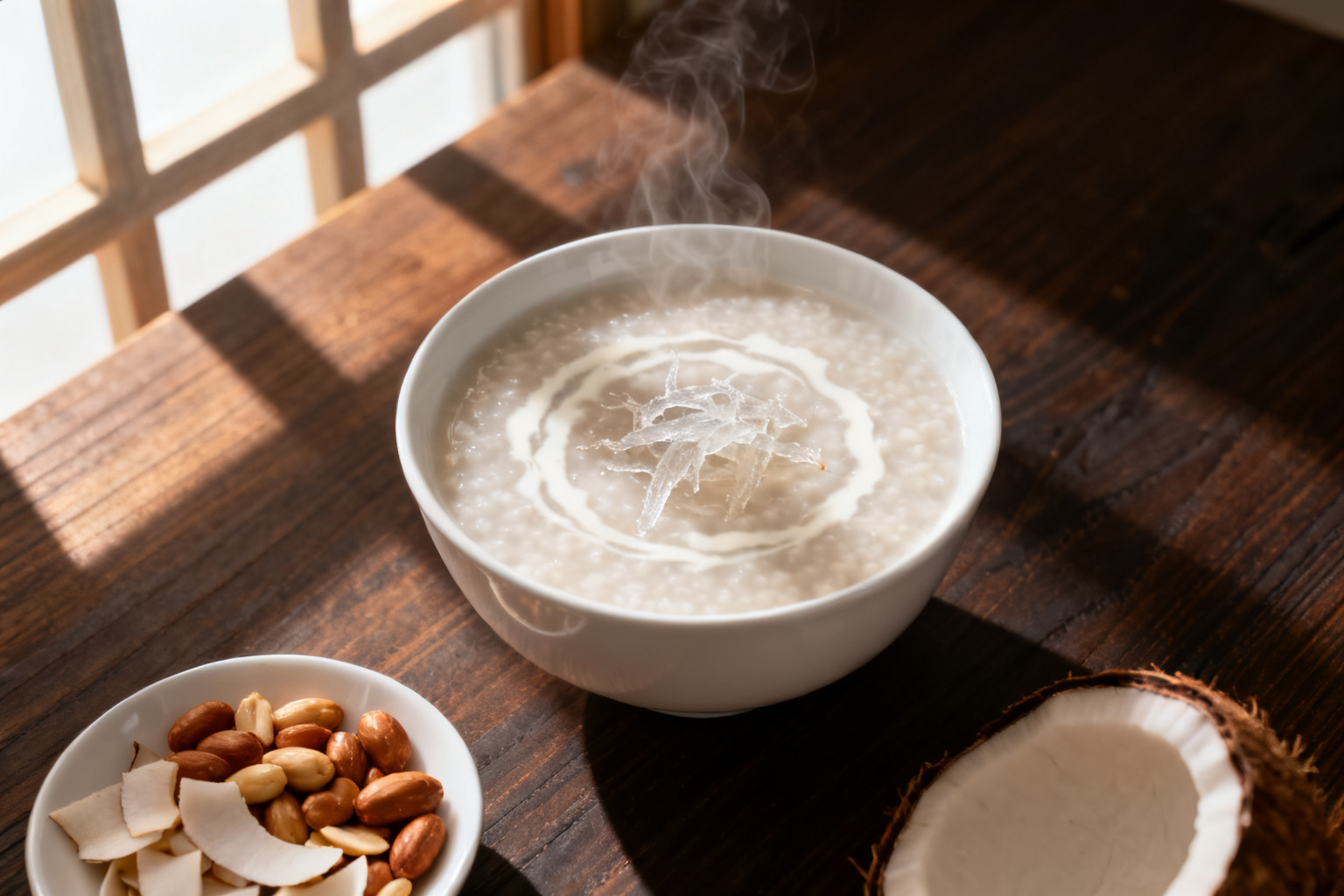
Coconut congee is what you want on a morning when the kitchen is cold and cooking feels unreasonable. Rice is cooked long enough that the grains stop being separate things and become one thick, glossy body, then finished with coconut milk so the bowl turns creamy without a drop of cream. The first spoon is hot. The second is sweet at the edges. By the third you have stopped thinking about the weather.
If you have ever asked what is congee, the short answer is this: rice cooked far past the point of separate grains, eaten across China and much of Asia, savoury in some regions and sweet in others. Chinese congee can be a plain white bowl with pickles on the side, or a sweet coconut congee like the one in front of you. Texture is the whole argument. It should hold a spoon and still slide off it.
This piece stays on the sweet, coconut-scented end of that family. It covers how to serve congee so the bowl lands right, what temperature and thickness to aim for, where instant congee fits into a weekday, and why a bowl like this belongs to cold mornings rather than to special occasions. Nothing here needs a trip to a specialist shop, and nothing needs an hour of stirring at the stove.
In This Article
Cold Mornings Ask for a Different Breakfast
Anyone who grew up eating rice in the morning will tell you that porridge for cold mornings is not a nutrition decision, it is a comfort one. Something warm, soft and lightly sweet at seven in the morning does more for a person than a cold drink does. That is why congee for breakfast has outlasted the cereal aisle and the smoothie phase. It is easy to eat before you are properly awake, and it never asks you to sit up straight or pick up a knife.
Time is the catch. A pot made properly takes an hour of watching, and on a weekday almost nobody has an hour. This is where quick congee for busy mornings makes sense, something you warm and eat rather than something you start and monitor. Anyone who has made pumpkin porridge from scratch knows the other side of it, the peeling, the stirring, the pot that needs attention exactly when you need to leave the house.
Where It Fits in a Normal Week
A bowl like this is not holiday food. The people who keep it in the cupboard are usually eating it two or three times a week, not once a year, and what it replaces is the meal nobody planned: the nine o’clock dinner after a late finish, the lunch that would otherwise be a bag of crisps, the morning when the milk has gone off. That is a modest job, and it is the job most worth doing well.
It also solves a specific problem in households where one person eats earlier than everyone else. Cooking a single portion of anything from scratch is hardly worth the washing up, which is how a person ends up eating biscuits over the sink at half past six. A bowl that can be warmed and eaten without a pot changes that morning more than any recipe does.
What the First Spoon Tells You
Temperature arrives first, texture half a second later. If the bowl is not hot enough, rice reads as paste. If it is too thin, it reads as soup with ambitions. Knowing how to serve congee is mostly knowing those two things: get it properly hot, keep it thick enough to hold a spoon, and let whatever goes on top add the contrast. A pinch of salt, a few crushed peanuts, a spoon of something sour, and the sweetness stops being one note.
The grain decides the rest. Millet porridge is looser, a little nutty, and it never develops that glossy, clinging body, which is exactly why some people want it in summer. Rice cooked down with coconut milk goes the opposite way, heavier and creamier, closer to pudding than to soup. That is also why the same bowl can sit on a menu beside a mango sago dessert without anyone finding it strange, cold and sweet in July, hot and sweet in January.
Why the Slow Version Still Sets the Standard
Bird nest congee is old food. It appears at banquet tables and in ordinary kitchens, and the method has barely changed: rice, water, long slow heat, and bird’s nest added near the end so the strands stay soft and slightly slippery instead of dissolving into nothing. Bird’s nest itself tastes of very little, which is why it takes on whichever liquid it is cooked in. Here that liquid is coconut.
Treating the old method as the standard rather than as decoration means the waiting stays in. A bowl that has been rushed tastes thin at the back, and no amount of topping hides it. It also means the argument about thickness never really ends. Families disagree, regions disagree, and there is no correct answer beyond what the cook grew up eating. Ours leans thick, because a thin bowl goes cold faster than a thick one.
The Part Worth Protecting
What is worth protecting in a bowl like this is the body. Glutinous rice gives it, breaking down into something that clings to the spoon, while a smaller share of regular rice keeps a few grains intact so the bowl is never one flat texture. Coconut milk goes in at the end rather than the start, because it needs to keep its perfume and it will catch if it sits over direct heat too long.
| Component | Job in the Pot | Texture It Builds | Point to Check |
|---|---|---|---|
| Glutinous rice | Thickens the bowl and gives it the cling | Soft, sticky, almost creamy | Too high a share turns everything pasty |
| Regular rice | Keeps a few whole grains so the spoon finds something | Tender grains that still hold shape | A grain that is undercooked at the start never softens later |
| Coconut milk | Brings fat, perfume and the creamy finish | Glossy, coating, slightly rich on the lip | Long direct heat dulls the aroma |
| Bird's nest | Adds soft, slippery strands and a faint savoury note under the sweet | Delicate, barely set | Left too long it dissolves and disappears |
| Water or light stock | Sets the final thickness of the bowl | Anywhere from spoon-standing to pourable | Adding it all at once is hard to undo |
Instant congee gets a bad reputation from the thin, pasty versions that taste of nothing but salt. Made with care, the format keeps the body of the slow version and gives up only the hour of stirring. That trade is worth naming honestly. You lose the smell of the pot on the stove, and you gain a hot bowl at twenty to seven on a Tuesday, which is when most people actually need one.
Two Bowls Worth Keeping at Home
The creamy, modern end of this is the Soy Coconut Bird Nest Congee. Soy milk and coconut milk together give it a rounder base than coconut alone, a little nutty at the back, and the bird’s nest sits in soft strands rather than vanishing. Warm it through, stir once so the top and bottom meet, and put something salty on top. Crushed peanuts, a pinch of flaked salt or a spoon of pickled vegetable all work.
If the creamy one sounds too soft and modern, the older style goes the other way entirely, plainer and more savoury, with no coconut to round the edges. The Bird Nest and Rice Congee is the bowl your grandparents would still recognise: rice, slow heat, bird’s nest, seasoning kept to a minimum. It is the one to open when you want congee rather than dessert, especially late at night or when nothing else appeals. Serve it with pickles, a salted egg or nothing at all.
Both bowls sit in the same nutritious porridge range, and both are worth keeping for mornings when the alternative is toast eaten standing up. Toppings are where a bowl becomes yours: something crunchy, something salty, something sharp. Coconut congee takes heat well, so a little chilli oil is less strange than it sounds. Start with a small spoon at the edge of the bowl and work inward.
One Thing to Remember
A bowl of rice congee is judged at the first spoon: hot enough to feel creamy, thick enough to hold its shape. Everything added afterwards, coconut, bird’s nest, a pinch of salt, is a finish on that base.
Frequently Asked Questions
Is bird nest congee worth the price?
You are paying for the bird’s nest itself, which is costly before anything is cooked, and for the slow hours you are not doing at home. Whether that adds up depends on how often you want the real thing. As a once-a-week bowl rather than a daily habit, the cost per serving is easier for most people to justify.
How should I serve coconut congee at home?
Warm it properly, stir it once so the top and bottom meet, then add texture: crushed peanuts, toasted sesame, a pinch of flaked salt, or sliced fruit if you want it sweeter. Keep the toppings small so the first spoon is still mostly congee. If it has thickened, loosen it with a splash of hot water rather than more coconut milk.
Should congee be eaten hot or cold?
Hot, in almost every case. Warmth is what makes the rice feel creamy instead of gluey, and it is the reason the bowl works in winter. Cold coconut congee is not wrong, though. Chilled, it moves toward dessert, and a spoon of mango on top takes it further in that direction without any extra work.
When is a bowl like this the right call?
Early mornings, late nights, and the flat hour after a long flight. It suits anyone who wants something soft and warm without cooking, and it suits a household where one person eats before the others are awake. It is a bowl rather than a whole morning, so add an egg or some nuts if lunch is far off.
How does instant congee compare with a pot made from scratch?
The scratch version wins on aroma and on the pleasure of standing over the pot with a wooden spoon. The instant one wins on Tuesday. What a good instant congee should give you is the same thick body and clean rice flavour. What it will not give you is the smell of the kitchen afterwards, which is a real part of the dish.